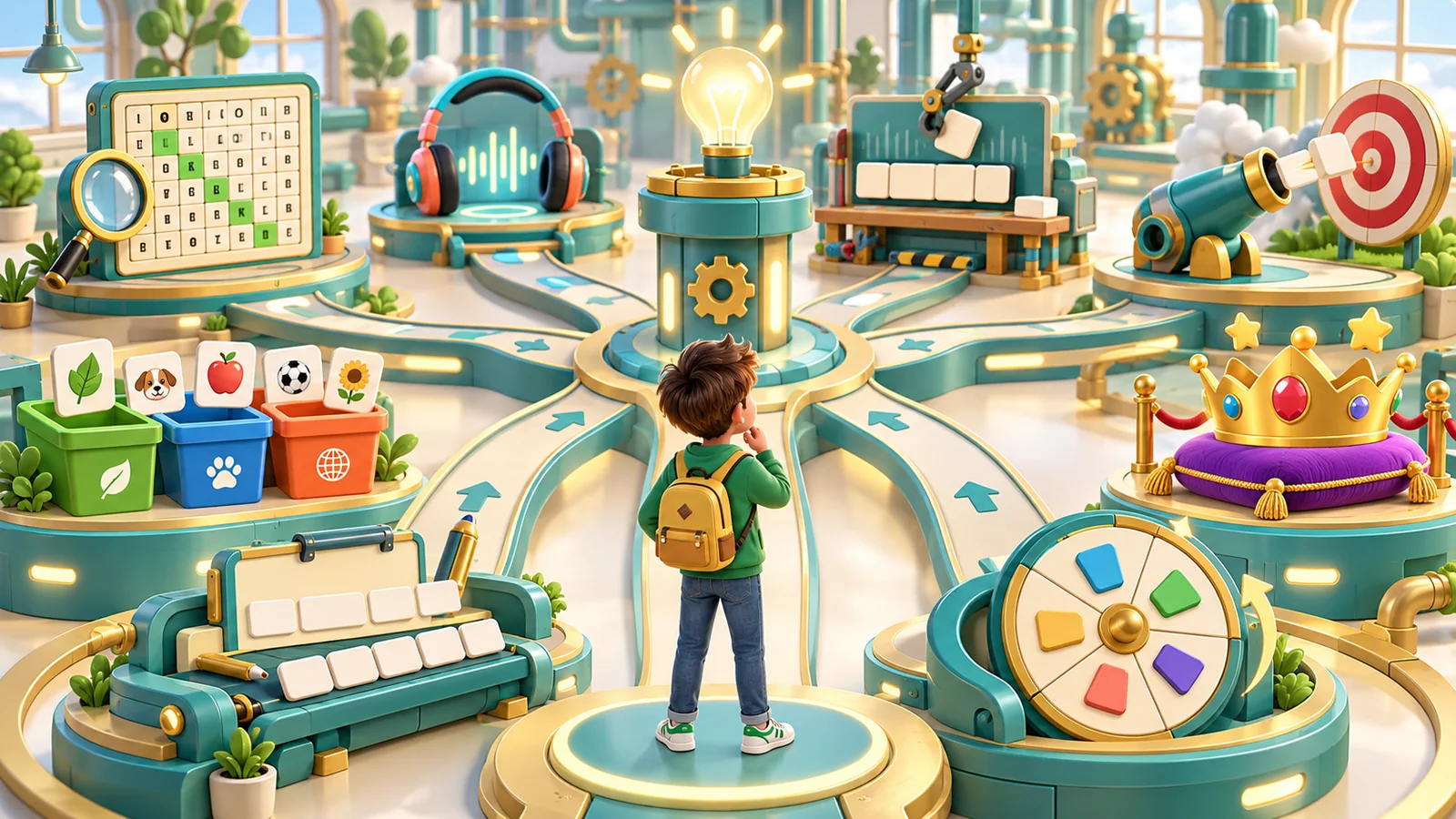
Quick answer: start with Word Search for visual recognition, Missing Letters for spelling recall, Word Cannon for meaning, Listen & Choose for sound-to-spelling practice, and Sentence Monster for vocabulary in context. The other three games add sorting, letter construction and path-planning challenges after the basic interaction feels comfortable.
Word Factory does not divide the Arcade into school grades or word categories. Each game starts at Level 1, then increases its own task difficulty across 1,000 levels. That makes the choice of game more important than choosing a category: the same learner may use one mode to discover a word and another to retrieve it later.
Eight games, eight kinds of practice
| Game | Main task | Best fit |
|---|---|---|
| Word Search | Trace hidden words in a letter grid. | Visual word recognition and careful spelling. |
| Word Cannon | Hit the moving word that matches a definition. | Fast meaning recognition under light time pressure. |
| Listen & Choose | Match a spoken word to one of four spellings. | Listening discrimination when an English browser voice is available. |
| Missing Letters | Repair incomplete words before time or chances run out. | Active letter recall and common spelling patterns. |
| Category Cards | Sort exposed words into meaning groups. | Semantic relationships and planning. |
| Letter Wheel | Build several target words from one wheel. | Flexible spelling and word-family exploration. |
| Sentence Monster | Reconstruct the missing word from a sentence or definition. | Using grammar and context to retrieve vocabulary. |
| Words Queen | Trace several target words through neighboring letters. | Spelling recall with spatial problem solving. |
A simple starting route
For a new player, we recommend a three-step route. First, use Word Search to learn the controls without a countdown. Second, move to Word Cannon or Category Cards so the answer depends on meaning rather than appearance alone. Third, use Missing Letters or Sentence Monster to retrieve the word instead of selecting it. This route moves from recognition to understanding to recall, while keeping each session short.
If a learner already reads English comfortably but hesitates when hearing words, begin with Listen & Choose instead. The game checks for browser Speech Synthesis and an installed English voice before loading. If the check fails, the player stays on the launch page rather than entering a silent round.
Worked example: practising one weak word
Imagine that a learner recognizes a target in Word Search but later misses its definition in Word Cannon. That result suggests that the visual form is familiar but the meaning is not yet secure. A useful next step is Category Cards or Sentence Monster, where surrounding categories or sentence context supply a second kind of clue. Returning to Missing Letters later asks for the spelling without presenting the complete answer.
Match the game to the device and setting
Word Search and Words Queen benefit from a larger touch area because players trace letter paths. Word Cannon is easier with a mouse or an accurately placed tap. Category Cards supports both taps and dragging. Listen & Choose needs audible output and is therefore a poor choice in a quiet shared room unless headphones are available. Every game also supports a pause action from the keyboard, but the primary controls remain usable by touch.
Short sessions work best when the goal is stated before play. “Finish one level without a hint” is more useful than “play for a while.” For children or first-time English learners, an adult can read the definition aloud and ask the learner to explain why an answer fits before tapping it.
What this comparison does not claim
The Arcade difficulty system is a game progression, not a validated school-grade sequence or a formal assessment. A higher level combines longer words, more targets, closer distractors or tighter task limits, but it does not certify vocabulary mastery. Browser voices also differ by device, so the listening experience is not identical everywhere.
Choose the game that makes the learner think about the intended skill, then stop or change modes when answers become automatic. You can review individual rules on each game page, compare progression in the level guide, or open all Word Factory games to begin at Level 1.